DANIEL LAWSON
Tsunami Chamber
Goal: Build an interactive museum exhibit that effectively teaches a class of 4th graders about resilience using Matlab, Arduino, and 3D printed components.
Background
This project was part of my Cornerstone of Engineering class. As a term project, we were to build an interactive project that taught children about resilience. My group chose to create a tsunami exhibit in which the 4th grader would build a wall and test its resilience against a simulated tsunami.
Initial Sketches and CAD
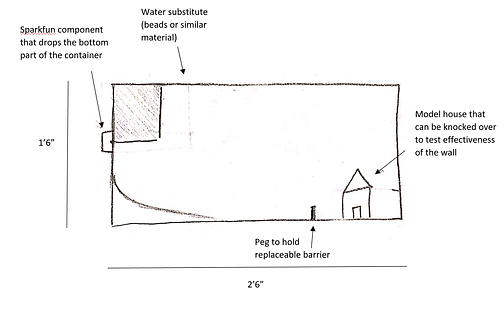
This was the initial design we chose when deciding which project idea to pursue. Some estimates of size can be seen on the side and bottom. The key components are marked with text and arrows.
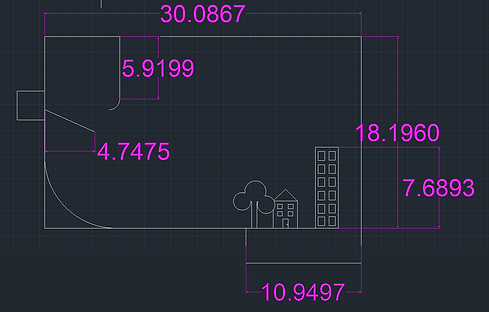
This is the first drawing of the project in AutoCAD. The measurements here were made to get an idea of sizing and were changed later to make the pieces easier to cut and create.
Prototyping
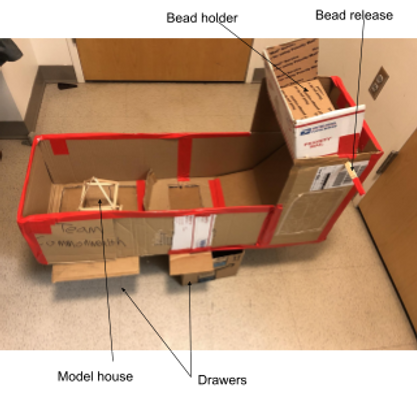
This is the first prototype of the exhibit, using cardboard, popsicle sticks, and duct tape. We chose these items because they are very cheap and easy to shape. Drawers were used as the mechanism for clearing the beads, but this was changed in the next iteration of the project. The Arduino was not included in the prototype and was substituted for a wood rod that pulled to release the beads.
Final Design
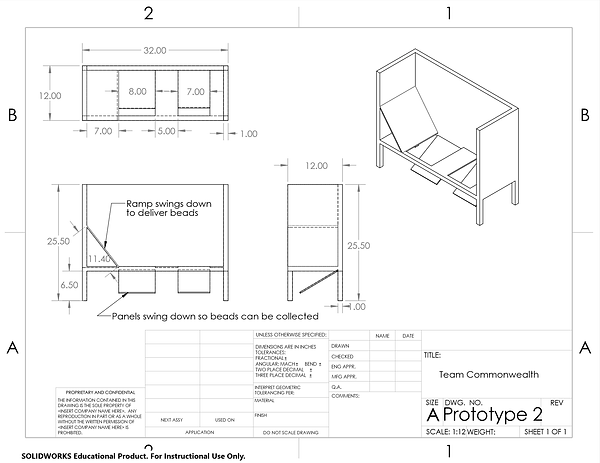
This was the SolidWorks drawing of the final design. It can be seen here that the drawers were replaced with hinged ramps to simplify the design and prevent the beads from getting trapped. The measurements in this drawing are the ones that were used in the final exhibit.
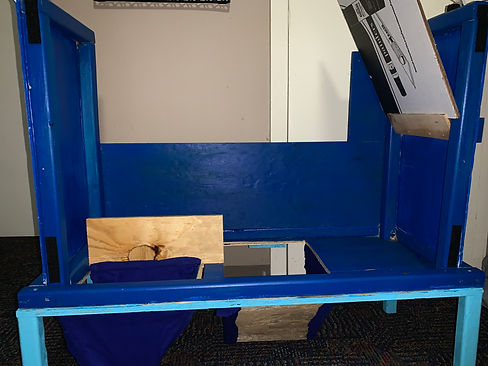
Almost the entire structure was built from wood. The pieces were cut and sized using a bandsaw and other more basic tools and were held together with screws. The left picture shows the painted frame completely assembled. The right picture shows the wiring diagram for the arduino motors used to drop the beads.

This was the final product. A MatLab interface can be seen on the computer. The students built their walls out of clay and popsicle sticks and placed them in front of Spongebob’s house. The project was successful as it taught kids about resiliency in a fun and interactive way.
